Shipping invoice template
Shipping invoice template is used by shippers and carriers to document freight charges after a shipment is moved. It is the billing document (freight invoice) that shows base freight, fuel surcharge, accessorials (liftgate, inside delivery), and any duties or taxes—distinct from the bill of lading (BOL), which is the contract and receipt of goods. Use it for LTL, FTL, and international shipments.
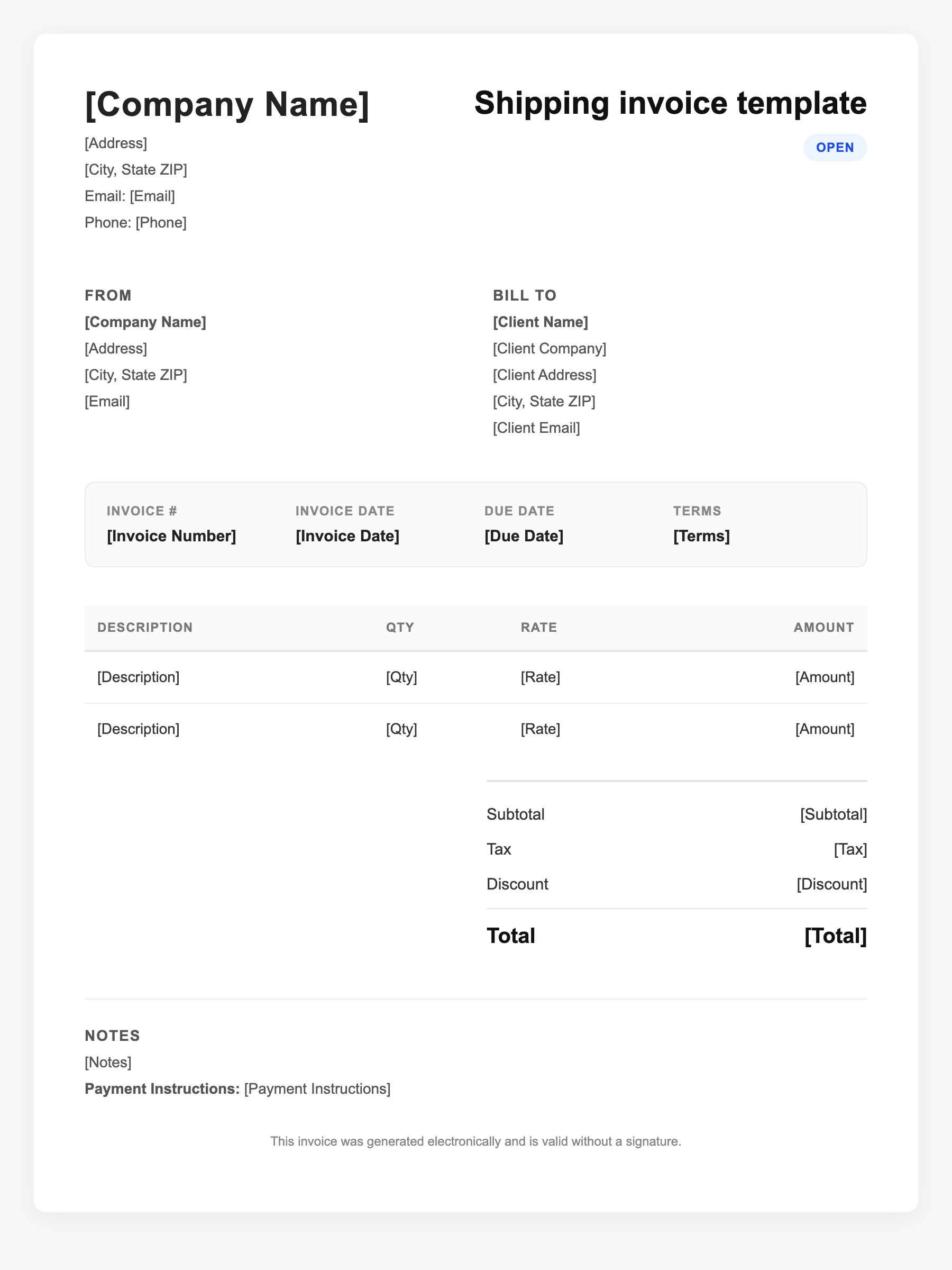
Shipping invoice template Sample
Shipping invoice template
123 Business Street, City, Country
Phone: (123) 456-7890
Email: contact@company.com
Shipping invoice template
Bill To:
Client Name
Client Address
Client City, Country
Phone: (987) 654-3210
Email: client@example.com
Invoice #: 12345
Date: 2024-10-10
Due Date: 2024-11-10
| Item | Description | Qty | Price | Total |
|---|---|---|---|---|
| Service A | Itemized service or product | 1 | $100.00 | $100.00 |
| Service B | Additional line item | 2 | $50.00 | $100.00 |
| Subtotal | $200.00 | |||
| Tax (10%) | $20.00 | |||
| Total Due | $220.00 | |||
An invoice should include your business or name, the customer’s details, the date and invoice number, and a line-by-line breakdown of what was provided. Including payment terms—such as due on receipt, Net 15, or Net 30—helps you get paid on time and keeps records clear for taxes.
Supporting resources
| Resource | Type | Description |
|---|---|---|
| Bill of lading vs freight invoice | Industry guide | BOL = contract of carriage and receipt of goods. Freight/shipping invoice = carrier’s bill for transportation services (charges, surcharges, fees). |
| NMFTA BOL standards | Trade association | National Motor Freight Traffic Association maintains uniform BOL terms and eBOL standards for LTL freight; invoices reference BOL for shipment details. |
| Commercial invoice (international) | Government | For international shipments, a commercial invoice (seller to buyer) is used for customs; carrier’s shipping invoice is separate and covers freight charges. |
| Freight invoice line items | Checklist | BOL or PRO number, origin/destination, base freight, fuel surcharge, accessorials (liftgate, inside delivery, etc.), and total. Reference to BOL for goods description. |
Frequently Asked Questions
- What is the difference between a shipping invoice and a bill of lading?
- The bill of lading (BOL) is the contract of carriage and receipt for the goods. The shipping (freight) invoice is the carrier’s bill for freight charges, surcharges, and fees. You need both for shipment and payment.
- When do I use a commercial invoice?
- Commercial invoice is used for international shipments to declare value and description for customs. The carrier may also send a separate freight invoice for transportation charges.
- What appears on a freight invoice?
- Typically: shipment reference (BOL/PRO number), base freight charges, fuel surcharge, accessorial charges (e.g., liftgate, inside delivery), and total amount due. It may reference the BOL for commodity and weight.