Receipt creator
Receipt creator is a digital tool for generating professional receipts after a sale or payment. It suits freelancers, retailers, and service providers who want to itemize products or services, quantities, rates, taxes, and payment terms in one layout. A well-structured receipt supports bookkeeping, reduces disputes, and gives customers a clear record for returns or expense reporting.
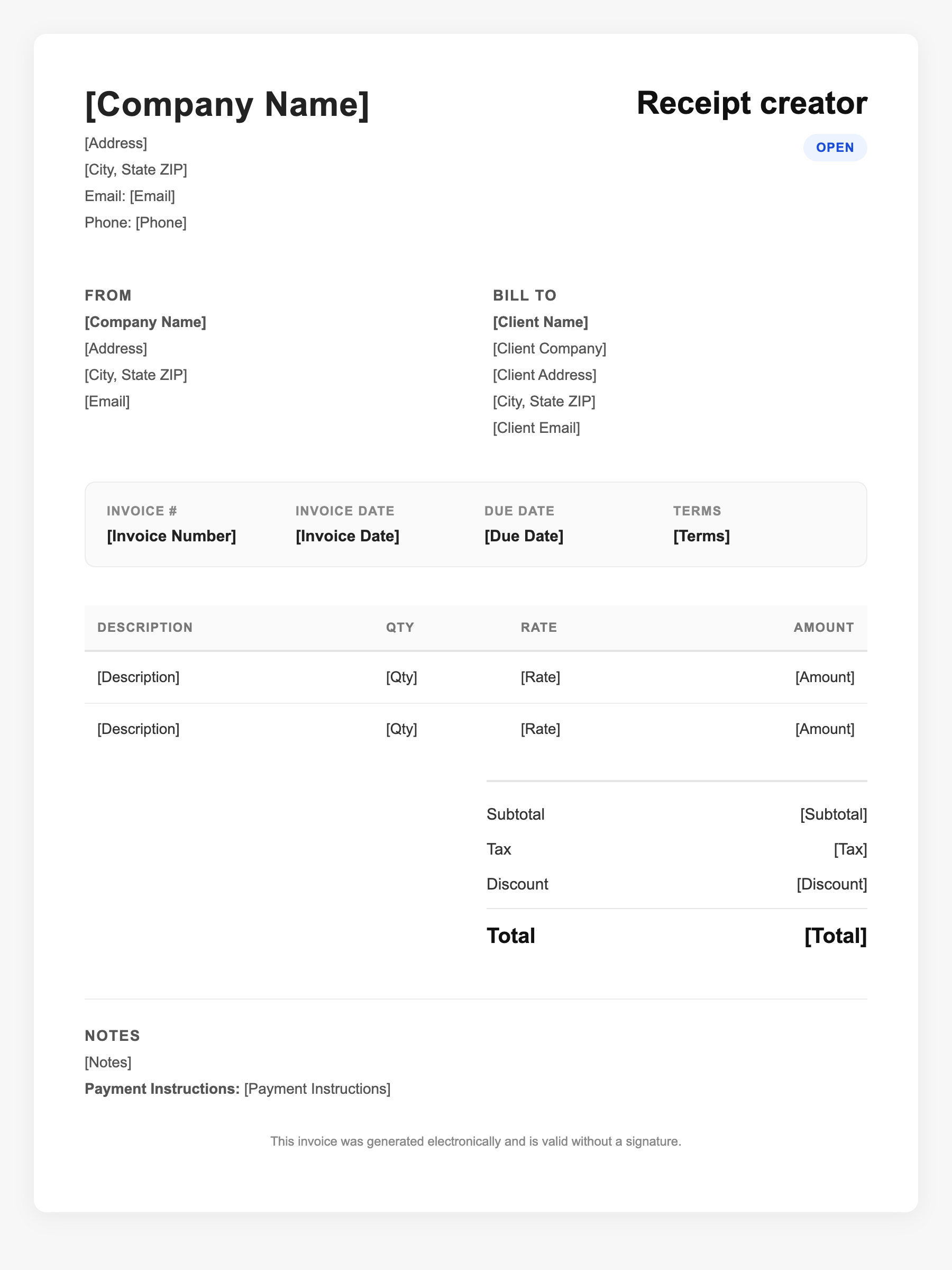
Receipt creator Sample
Receipt creator
123 Business Street, City, Country
Phone: (123) 456-7890
Email: contact@company.com
Receipt creator
Bill To:
Client Name
Client Address
Client City, Country
Phone: (987) 654-3210
Email: client@example.com
Invoice #: 12345
Date: 2024-10-10
Due Date: 2024-11-10
| Item | Description | Qty | Price | Total |
|---|---|---|---|---|
| Product A | Item purchased | 1 | $49.00 | $49.00 |
| Product B | Item purchased | 2 | $22.00 | $44.00 |
| Subtotal | $93.00 | |||
| Tax (10%) | $9.30 | |||
| Total Due | $102.30 | |||
An invoice should include your business or name, the customer’s details, the date and invoice number, and a line-by-line breakdown of what was provided. Including payment terms—such as due on receipt, Net 15, or Net 30—helps you get paid on time and keeps records clear for taxes.
Supporting resources
| Resource | Type | Description |
|---|---|---|
| Receipt elements (IRS) | Government | Records must substantiate income and expenses. Include seller and buyer details, date, amount, description of goods or services, and payment method. |
| Itemized receipt best practices | Checklist | List each item with quantity, unit price, line total; show subtotal, tax breakdown, grand total; include receipt number and payment method. |
| Stripe receipt guide | Industry guide | What to include in receipts for different use cases: document label, receipt number, date, seller/buyer details, description, amount, payment method. |
Frequently Asked Questions
- What should a receipt from a receipt creator include?
- Business and customer details, receipt number, date, itemized line items (description, quantity, price), subtotal, tax, total, and payment method.
- Is a digital receipt legally valid?
- Yes. Digital receipts are generally valid for tax and proof-of-purchase purposes if they contain the same information as a paper receipt and can be retained.
- Why use a receipt creator instead of handwritten notes?
- Consistent formatting improves record-keeping, reduces errors, and looks professional. Itemized digital receipts are easier to store and search for audits.