Receipt template
Receipt template provides proof of payment for goods or services. It includes the transaction or receipt number, date and time, vendor details, itemized items with prices, tax, total paid, and payment method. Receipts support returns, warranties, expense reimbursement, and tax records; itemized receipts are stronger proof than a single total.
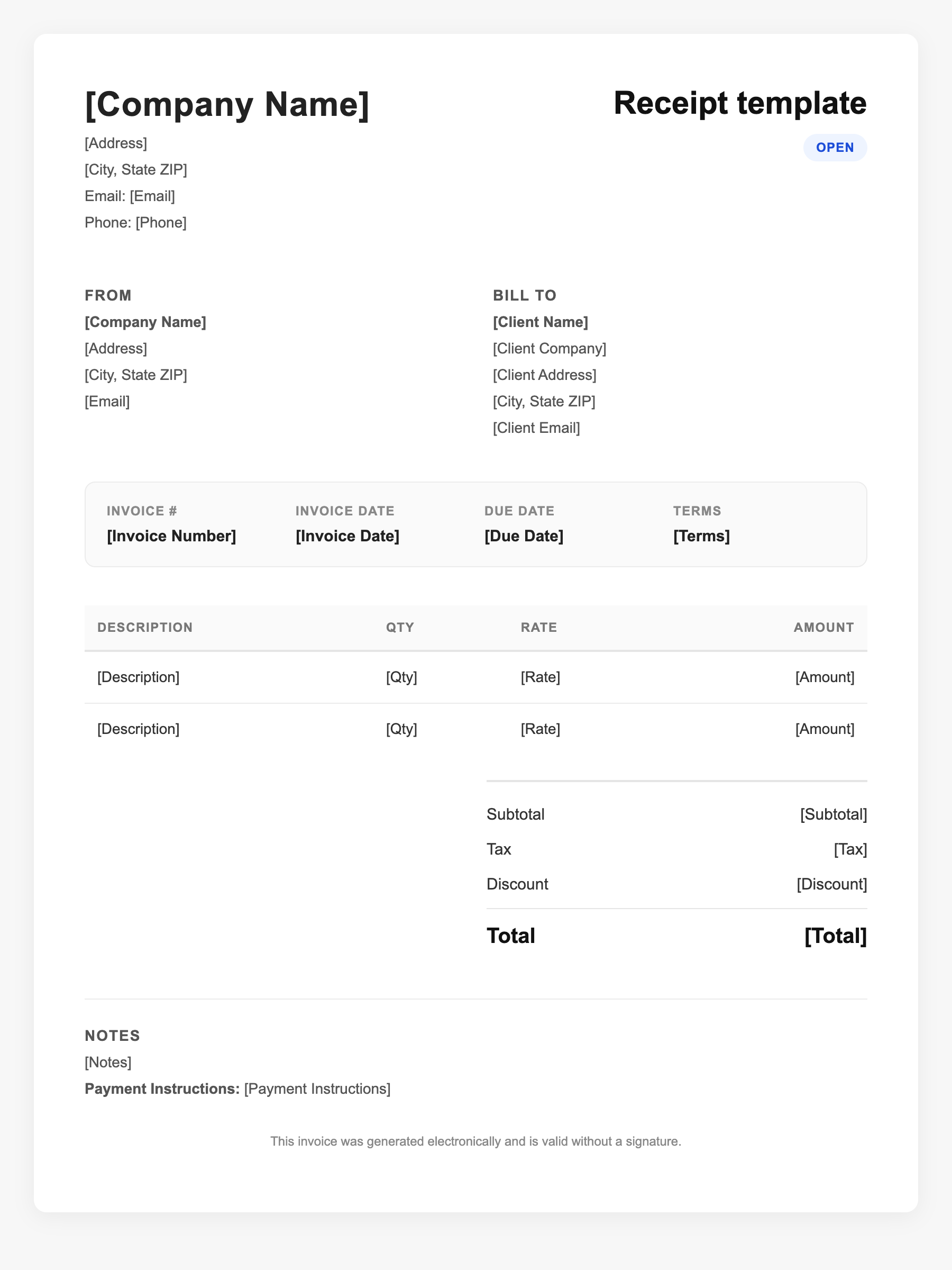
Receipt template Sample
Receipt template
123 Business Street, City, Country
Phone: (123) 456-7890
Email: contact@company.com
Receipt template
Bill To:
Client Name
Client Address
Client City, Country
Phone: (987) 654-3210
Email: client@example.com
Invoice #: 12345
Date: 2024-10-10
Due Date: 2024-11-10
| Item | Description | Qty | Price | Total |
|---|---|---|---|---|
| Product A | Item purchased | 1 | $49.00 | $49.00 |
| Product B | Item purchased | 2 | $22.00 | $44.00 |
| Subtotal | $93.00 | |||
| Tax (10%) | $9.30 | |||
| Total Due | $102.30 | |||
An invoice should include your business or name, the customer’s details, the date and invoice number, and a line-by-line breakdown of what was provided. Including payment terms—such as due on receipt, Net 15, or Net 30—helps you get paid on time and keeps records clear for taxes.
Supporting resources
| Resource | Type | Description |
|---|---|---|
| Valid receipt elements | Checklist | Receipt number, date/time, vendor name and address, itemized goods or services with quantities and prices, tax, total, payment method (card last 5 digits only per FACTA). |
| FACTA and card receipts | Government | Printed card receipts may show only the last 5 digits of the card number; expiration date must not appear. Full card number must not be stored or printed for receipts. |
| IRS and recordkeeping | Government | Businesses often keep receipt copies 3–7 years; receipts support deductions and expense documentation. |
Frequently Asked Questions
- What is the difference between a receipt and an invoice?
- An invoice is a request for payment (sent before or with the bill). A receipt is proof that payment was received (issued after payment).
- What must a receipt include for tax purposes?
- Vendor name/address, date, description of goods or services, amount paid, and payment method. Itemized detail strengthens support for deductions.
- Can a digital receipt replace a printed one?
- Yes; the IRS accepts digital receipts and records. Ensure the electronic receipt has the same key details and is retained in a way you can produce if audited.