Legal invoice template
Legal invoice template is for attorneys and legal professionals billing clients by time, flat fee, or hybrid. Entries should be specific and tied to the matter; firms typically use 6–15 minute billing increments and integrate time tracking with invoicing. Transparent, well-documented invoices support client trust and comply with ethics rules on reasonable fees and fee communication.
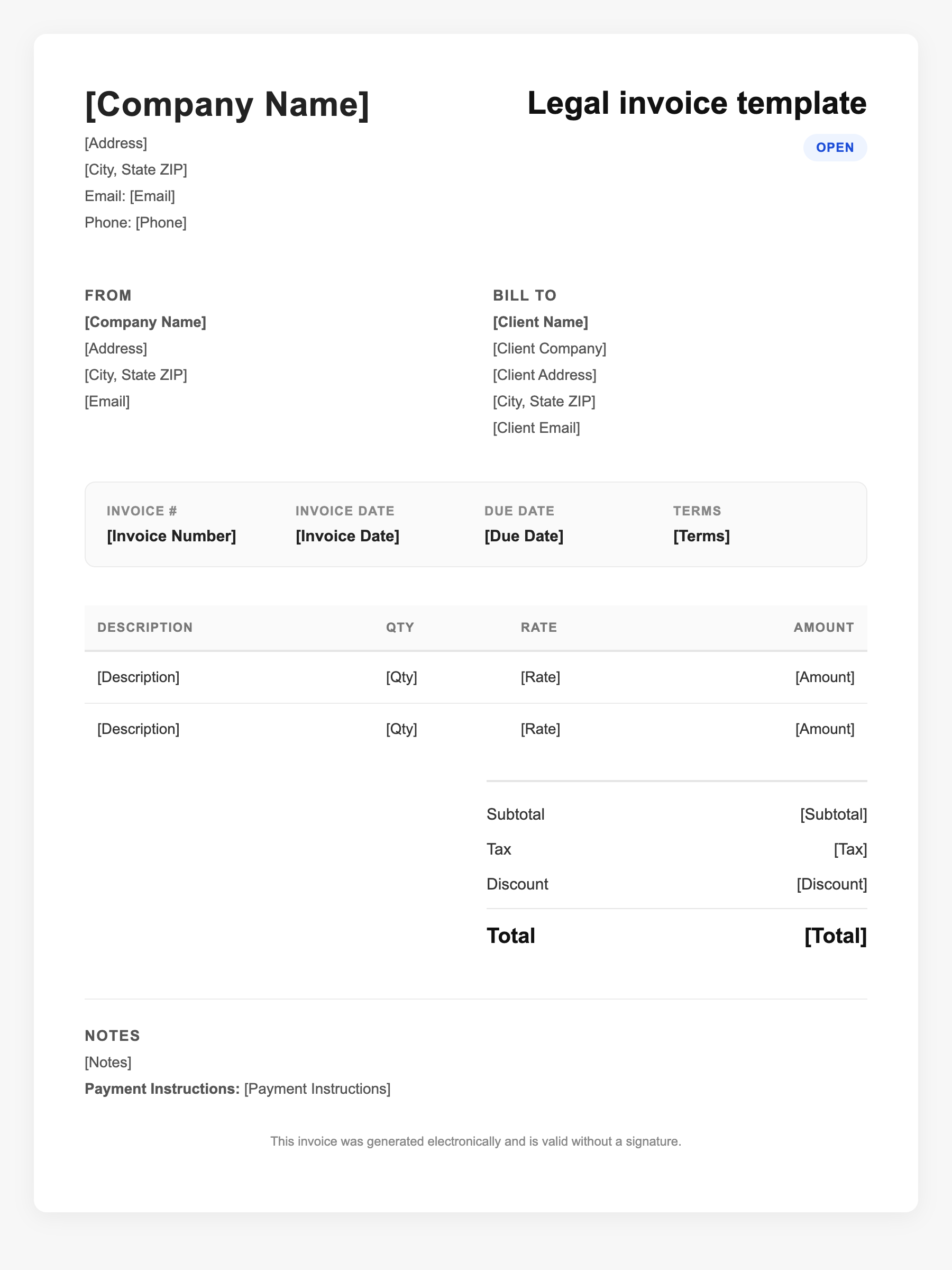
Legal invoice template Sample
Legal invoice template
123 Business Street, City, Country
Phone: (123) 456-7890
Email: contact@company.com
Legal invoice template
Bill To:
Client Name
Client Address
Client City, Country
Phone: (987) 654-3210
Email: client@example.com
Invoice #: 12345
Date: 2024-10-10
Due Date: 2024-11-10
| Item | Description | Qty | Price | Total |
|---|---|---|---|---|
| Service A | Itemized service or product | 1 | $100.00 | $100.00 |
| Service B | Additional line item | 2 | $50.00 | $100.00 |
| Subtotal | $200.00 | |||
| Tax (10%) | $20.00 | |||
| Total Due | $220.00 | |||
An invoice should include your business or name, the customer’s details, the date and invoice number, and a line-by-line breakdown of what was provided. Including payment terms—such as due on receipt, Net 15, or Net 30—helps you get paid on time and keeps records clear for taxes.
Supporting resources
| Resource | Type | Description |
|---|---|---|
| What counts as billable hours | Checklist | Drafting, client meetings, court appearances, research, depositions, and case review are billable; admin and internal meetings generally are not. |
| Attorney billing increments | Industry guide | 6-, 10-, or 15-minute increments standard; improves capture, reduces disputes, and keeps invoices defensible; round to increment per activity. |
| Time tracking and legal invoicing | Industry guide | Software that links time entries to matters and invoices; batch invoicing, line-item detail, and unbilled time visibility. |
Frequently Asked Questions
- What should a legal invoice include?
- Matter name/number, client, billing period, itemized time (date, attorney, task, time, rate, amount), expenses, total, and payment terms; descriptions should be specific and matter-related.
- How do lawyers track billable time?
- Many use legal practice management or time-and-billing software with timers and matter codes; manual logs work but require discipline to avoid underreporting.
- Why use billing increments for legal work?
- Increments (e.g., 0.1 hour) standardize billing, capture short tasks fairly, and give clients a clear, defensible breakdown; state or client guidelines may specify increment size.