Invoicing templates
Invoicing templates are reusable layouts for creating invoices across jobs, clients, and projects. They can be general-purpose or tailored (e.g., service vs. product, hourly vs. project). Good templates include consistent branding, clear line-item structure, and space for payment terms; many businesses use one master template in Word, Excel, or an app and duplicate it per invoice. Standardizing with invoicing templates speeds up billing and reduces errors.
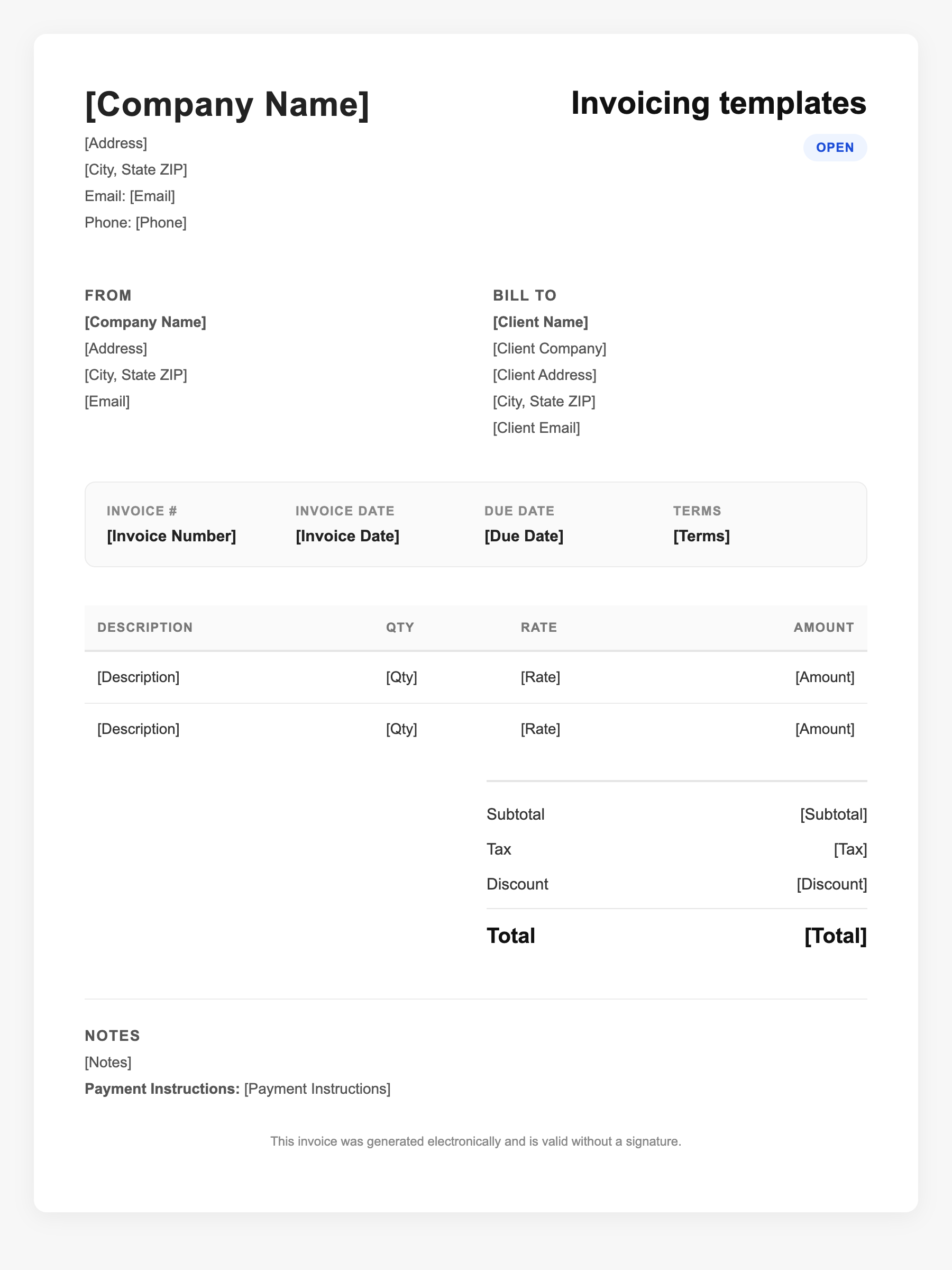
Invoicing templates Sample
Invoicing templates
123 Business Street, City, Country
Phone: (123) 456-7890
Email: contact@company.com
Invoicing templates
Bill To:
Client Name
Client Address
Client City, Country
Phone: (987) 654-3210
Email: client@example.com
Invoice #: 12345
Date: 2024-10-10
Due Date: 2024-11-10
| Item | Description | Qty | Price | Total |
|---|---|---|---|---|
| Service A | Professional services | 1 | $100.00 | $100.00 |
| Service B | Additional work or materials | 2 | $50.00 | $100.00 |
| Subtotal | $200.00 | |||
| Tax (10%) | $20.00 | |||
| Total Due | $220.00 | |||
An invoice should include your business or name, the customer’s details, the date and invoice number, and a line-by-line breakdown of what was provided. Including payment terms—such as due on receipt, Net 15, or Net 30—helps you get paid on time and keeps records clear for taxes.
Supporting resources
| Resource | Type | Description |
|---|---|---|
| Invoice best practices | Checklist | Unique invoice number and date; your and client details; itemized description, qty, rate, amount; subtotal, tax, total; payment terms and due date; how to pay. |
| Small business invoicing guide | Industry guide | Templates, payment terms (Net 15/30/60), early-payment discounts; tools and automation options. |
| Template consistency | Benchmark | Same layout and fields each time improves clarity, speeds processing, and supports record-keeping and audits. |
Frequently Asked Questions
- What’s the benefit of using invoicing templates?
- Faster creation, consistent look, fewer mistakes, and a clear record. One template (or a small set) keeps your process simple and professional.
- Should I have different templates for different services?
- Optional. One flexible template often suffices. Use separate templates if you have very different layouts (e.g., retainer vs. project) or branding per division.
- How do I keep invoicing templates up to date?
- Review when your branding, tax rate, or terms change. Update the master file and use the new version for all future invoices; keep old invoices as-is for history.