Home Insurance Claim invoice template
Home insurance claim invoice template is used by contractors and homeowners to submit repair or rebuild costs to insurers after a covered loss. Insurers expect detailed, insurance-ready invoices: line items tied to estimate codes, labor and material breakdowns, photos or references to scope, and loss/claim info. Vague or lump-sum invoices are a common reason for delays or denials.
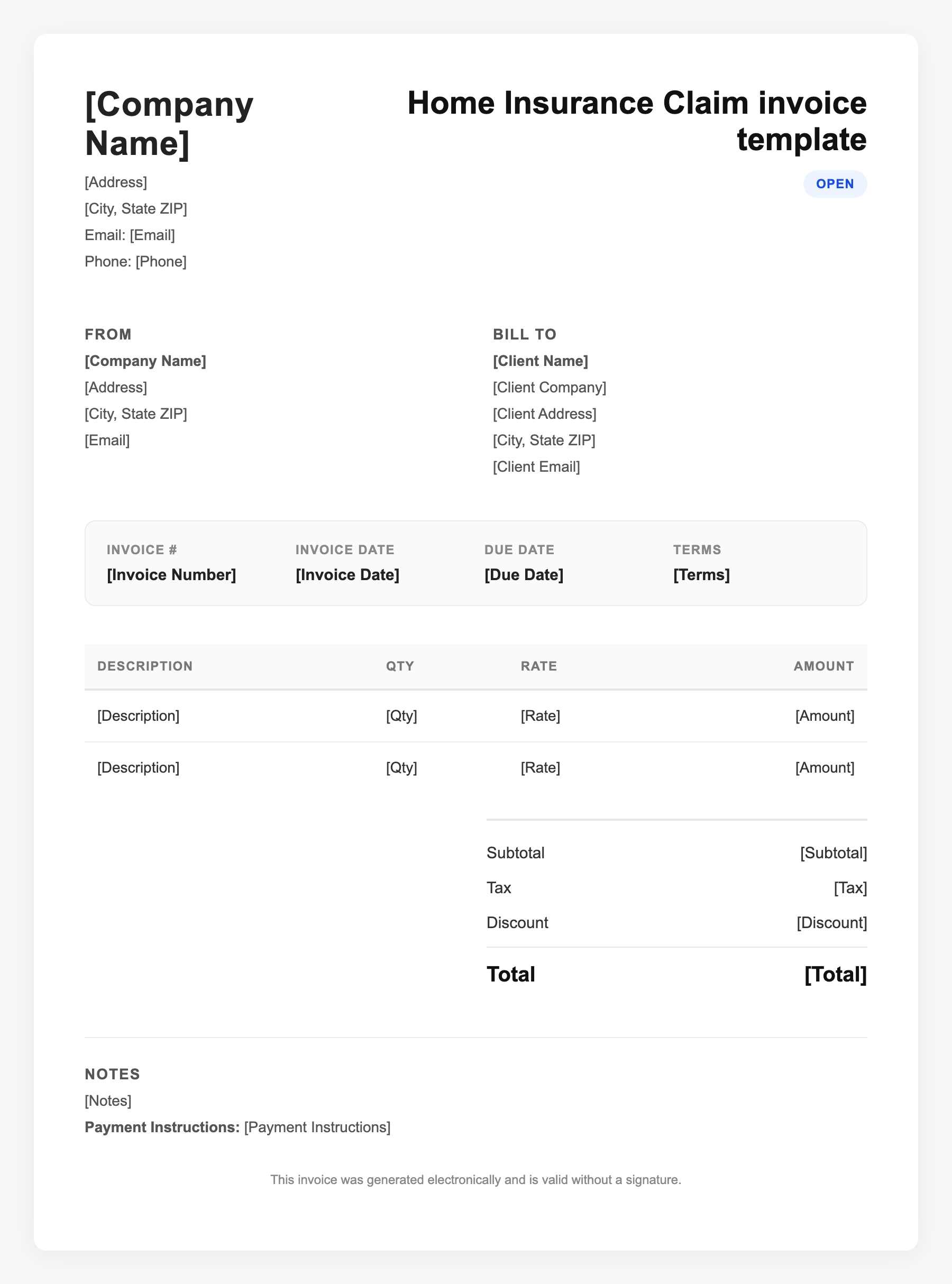
Home Insurance Claim invoice template Sample
Home Insurance Claim invoice template
123 Business Street, City, Country
Phone: (123) 456-7890
Email: contact@company.com
Home Insurance Claim invoice template
Bill To:
Client Name
Client Address
Client City, Country
Phone: (987) 654-3210
Email: client@example.com
Invoice #: 12345
Date: 2024-10-10
Due Date: 2024-11-10
| Item | Description | Qty | Price | Total |
|---|---|---|---|---|
| Service A | Itemized service or product | 1 | $100.00 | $100.00 |
| Service B | Additional line item | 2 | $50.00 | $100.00 |
| Subtotal | $200.00 | |||
| Tax (10%) | $20.00 | |||
| Total Due | $220.00 | |||
An invoice should include your business or name, the customer’s details, the date and invoice number, and a line-by-line breakdown of what was provided. Including payment terms—such as due on receipt, Net 15, or Net 30—helps you get paid on time and keeps records clear for taxes.
Supporting resources
| Resource | Type | Description |
|---|---|---|
| Insurance-ready contractor invoice | Checklist | Signature blocks (contractor and homeowner); photos or blueprint refs per line; material SKUs, quantities, unit costs, proof of purchase; labor by trade, hours, crew, wage; scope and carrier estimate codes; loss date, location, claim number. |
| Proof of Loss | Government / Industry | Formal sworn statement of loss and value; insurers may require it; can be submitted in stages; puts carrier on clock to respond. |
| Common rejections | Checklist | Arithmetic errors; missing tie to approved estimate codes; vague lines (e.g. ‘misc. carpentry’); lump sums without unit costs. |
| Documenting damage | Industry guide | Photos, videos, receipts; document before repairs; keep temp repair receipts; submit estimates and invoices promptly. |
Frequently Asked Questions
- What makes an invoice acceptable for a home insurance claim?
- Carriers want line-by-line detail: labor and materials, quantities and unit prices, alignment with their estimate or scope, and loss/claim identifiers. Avoid single lump sums and vague descriptions.
- When should I submit the contractor invoice to the insurer?
- Submit as soon as work is complete (or in phases for large jobs). Submitting within about 48 hours of completion can speed review and payment.
- What is a Proof of Loss and do I need it?
- A Proof of Loss is a signed, often notarized statement of the loss and value. Your policy may require it; submitting it can trigger the insurer’s obligation to respond. Supplemental proofs of loss can be sent as scope is finalized.