Bill template
Bill template is a request-for-payment document from the buyer’s perspective—what they owe. In everyday use “bill” and “invoice” are often the same document: the seller issues an invoice, the buyer treats it as a bill to pay. Use this template for utilities, services, or one-off charges where you want a clear “amount due” layout.
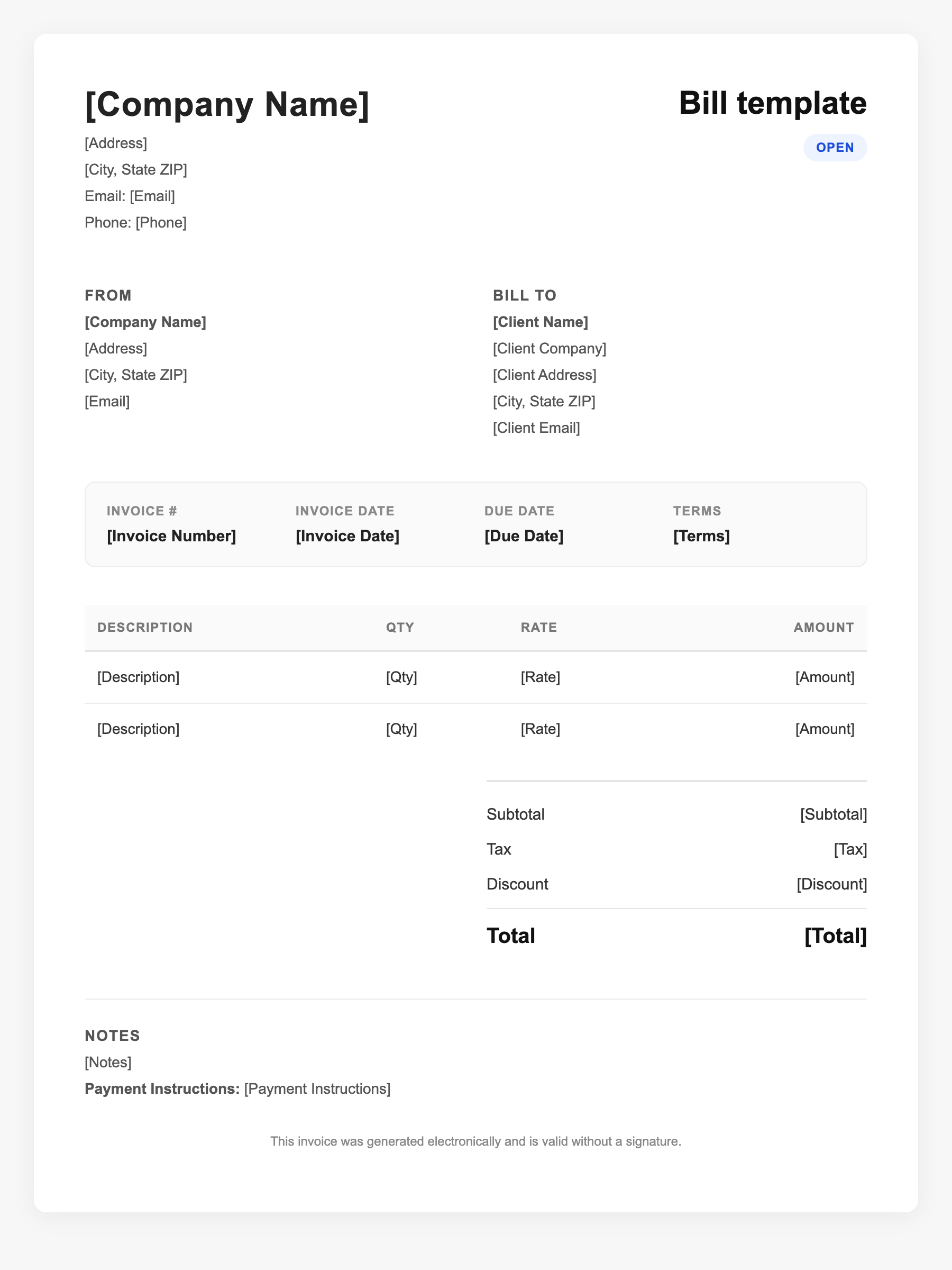
Bill template Sample
Bill template
123 Business Street, City, Country
Phone: (123) 456-7890
Email: contact@company.com
Bill template
Bill To:
Client Name
Client Address
Client City, Country
Phone: (987) 654-3210
Email: client@example.com
Invoice #: 12345
Date: 2024-10-10
Due Date: 2024-11-10
| Item | Description | Qty | Price | Total |
|---|---|---|---|---|
| Service A | Professional services | 1 | $100.00 | $100.00 |
| Service B | Additional work or materials | 2 | $50.00 | $100.00 |
| Subtotal | $200.00 | |||
| Tax (10%) | $20.00 | |||
| Total Due | $220.00 | |||
An invoice should include your business or name, the customer’s details, the date and invoice number, and a line-by-line breakdown of what was provided. Including payment terms—such as due on receipt, Net 15, or Net 30—helps you get paid on time and keeps records clear for taxes.
Supporting resources
| Resource | Type | Description |
|---|---|---|
| Bill vs. invoice (Paystand) | Industry guide | Same document, different perspective: seller’s invoice = buyer’s bill; invoice often has terms and due date, bill implies amount due. |
| The Balance – Invoice vs. bill | Industry guide | Bill usually implies more immediate payment (e.g., restaurant, utilities); invoice often used in B2B with payment terms. |
| IRS record-keeping | Government | Keep bills/invoices as supporting documents for income and expenses; identify payee, amount, date, and description. |
Frequently Asked Questions
- What is the difference between a bill and an invoice?
- Often the same document: the seller calls it an invoice, the buyer calls it a bill. “Bill” is often used when payment is due soon (e.g., restaurant tab, utility bill); “invoice” is common in B2B with stated payment terms.
- When should I use a bill template?
- Use a bill template whenever you need to show a customer or client what they owe—one-off or recurring. Suits service providers, freelancers, and small businesses who want a simple “amount due” format.
- Does a bill need to include payment terms?
- Including due date and payment method helps avoid confusion and speeds payment. For B2B or larger amounts, terms (e.g., Net 30) are standard.