Artwork invoice template
Artwork invoice template is used to document the sale or transfer of a specific piece of artwork, including title, medium, dimensions, condition, and price. It serves as a bill for payment and as a record of provenance and value for insurance and resale. Galleries, artists, and dealers use it for primary and secondary market transactions.
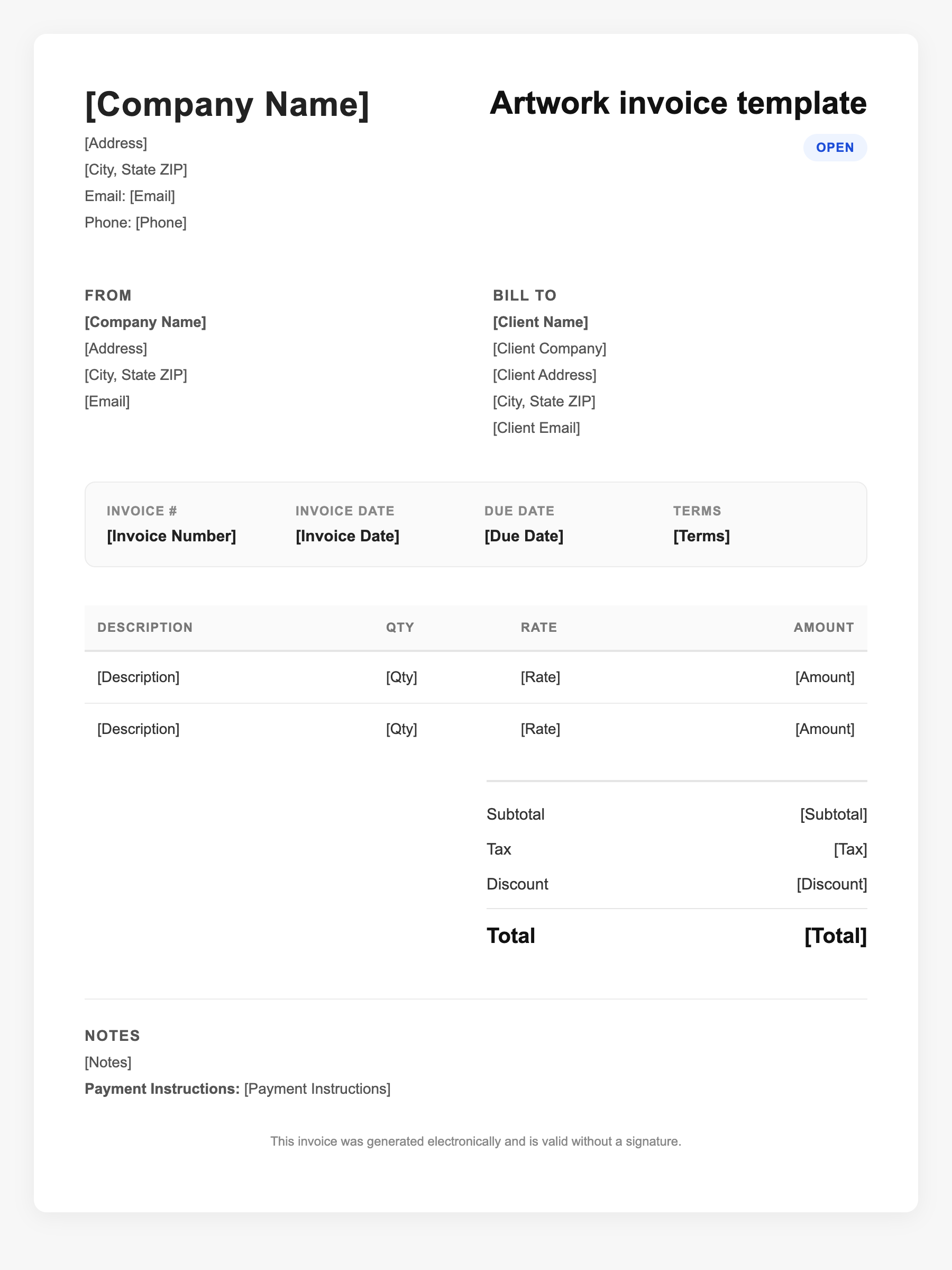
Artwork invoice template Sample
Artwork invoice template
123 Business Street, City, Country
Phone: (123) 456-7890
Email: contact@company.com
Artwork invoice template
Bill To:
Client Name
Client Address
Client City, Country
Phone: (987) 654-3210
Email: client@example.com
Invoice #: 12345
Date: 2024-10-10
Due Date: 2024-11-10
| Item | Description | Qty | Price | Total |
|---|---|---|---|---|
| Service A | Itemized service or product | 1 | $100.00 | $100.00 |
| Service B | Additional line item | 2 | $50.00 | $100.00 |
| Subtotal | $200.00 | |||
| Tax (10%) | $20.00 | |||
| Total Due | $220.00 | |||
An invoice should include your business or name, the customer’s details, the date and invoice number, and a line-by-line breakdown of what was provided. Including payment terms—such as due on receipt, Net 15, or Net 30—helps you get paid on time and keeps records clear for taxes.
Supporting resources
| Resource | Type | Description |
|---|---|---|
| Provenance and value | Guideline | Invoice is key evidence of ownership transfer and sale price for insurance, estate, and future sales. |
| Invoice fields for artwork | Checklist | Seller and buyer, date, invoice number, artwork title, artist, medium, dimensions, edition (if applicable), price, shipping/insurance, tax, payment terms. |
| Gallery and consignment | Industry guide | When a gallery sells on consignment, their invoice to the buyer may reference the consignment; artist receives share per agreement. |
Frequently Asked Questions
- What is the difference between an artwork invoice and a receipt?
- An invoice is the bill sent before or at sale requesting payment; a receipt confirms payment was received. For art, the invoice often doubles as the main record of sale and value.
- Why put dimensions and medium on an artwork invoice?
- They identify the exact piece for provenance, insurance, and condition reports; essential for unique works and editions.
- Should an artwork invoice include a condition statement?
- For high-value or secondary market sales, a brief condition note or reference to a condition report can support the sale and reduce disputes.